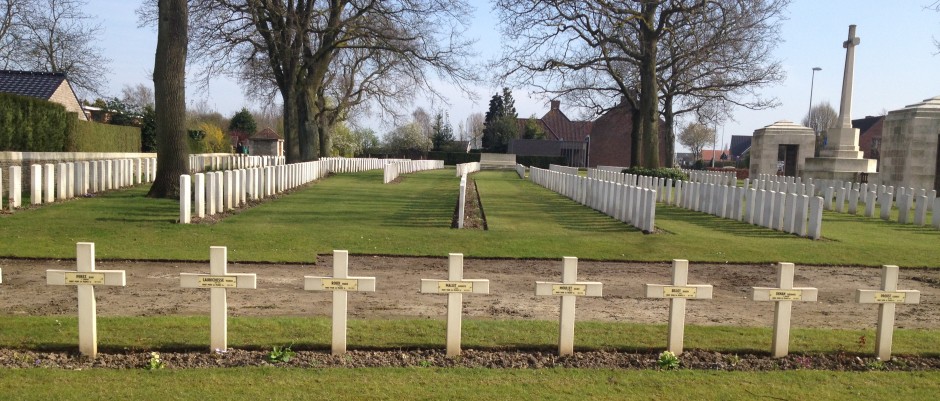
The Germans decisively won the Battle of the Frontiers in August 1914 and lost the Battle of the Marne in early September. Or, more accurately, the French Commander in Chief, Joffre, brilliantly manoeuvred his initially defeated forces, and exploited the German errors and over-stretch to decisive effect, as we shall see.
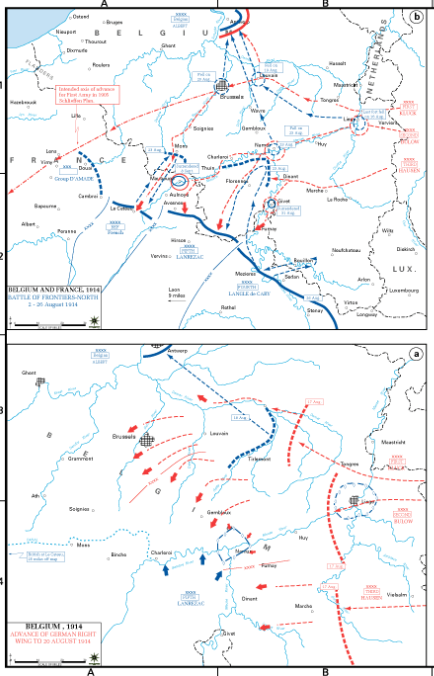
Battle of the Frontiers – the German Advance through Belgium
After the declarations of War at the start of August, the German Army, led by the Younger Moltke, mobilized according to the programme set in their Schlieffen Plan and its integral train timetables. These demanded that no less than 20,800 trains be run in the first 20 days of war, each with 50 wagons, capable of transporting 1,300,000 men, 118,000 horses and 400,000 tons of material to the Front along 13 separate rail routes to the west.
The French, equally single-mindedly led by Joffre, applied their own Plan XVII which called for concentration in their Centre, on German-occupied Lorraine, together with an advance through Luxembourg into the German Saarland and Moselle. (See the maps in the blogs below.)
As every British schoolchild now knows, the Schlieffen Plan called for the German Army to hinge around its 4th Army and advance through Belgium, with the 1st Army “brushing the Channel with its right sleeve” then passing west of Paris, and then act with the 2nd and 3rd Armies as the “hammer” to destroy the (apparently compliant) French army on the “anvil” of the 4th, 5th and 6th Armies.

Men of the Hertfordshire Regimnet mobilise. Delightful photo that has colour added.
As a result of unofficial and “non-committal” Staff Talks authorised by the Foreign Secretary Sir Edward Grey in 1906, the BEF’s role was to be deployed under on the left wing of the French Army. These deployments were hardened up by the francophile Director of Military Operations, Sir Henry Wilson, to include the initial dispatch of a BEF of 4 infantry divisions and one cavalry division, to be augmented by two more infantry divisions and a further cavalry division once the Territorials could defend Britain.
French thinking here was, clearly, not to acquire the might of the British Army – which neither they nor the Germans rated highly – but rather, by securing the commitment of the BEF, to bind Britain and her naval and financial power into the Franco-Russian alliance against Germany. Therefore the BEF was posted on the far left of the French frontline, around Mauberge, well away from where the French General Staff expected the decisive battles to occur.
Indeed, when Sir Henry Wilson when he was head of the Army Staff College at Camberley asked Marshal Foch, who at that time very influentially ran the French Ecole Superieure de la Guerre (where he pushed the suicidal doctrine of all attack by infantry) “What would you say is the smallest British military force that would be of practical assistance to you?”, Foch replied, “One single private soldier – and we would take good care that he was killed”. It was Britain’s commitment, the Royal Navy and her wealth, that mattered to France, not the 6 divisions of the BEF that mattered to France.
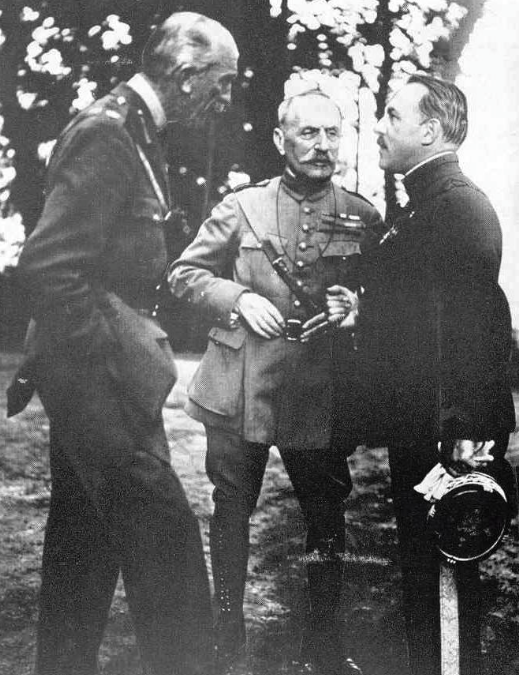
Sir Henry Wilson, Ferdinand Foch and a Col Huguet
Prime Minister Asquith and Foreign Secretary Grey had not shared the Commitment with the full Cabinet – and although joining the Continental War was avoidable – once the Government was committed to War and War was declared in August 1914, the British decided to execute Wilson’s “Continental Commitment”. The BEF – led by Field Marshall Sir John French – therefore found itself on the far left of the French Army, in the path of the German right wing swinging down from Belgium in execution of the Schleiffen Plan.
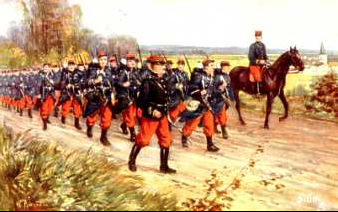
French Infantry in the uniform of August 1914
During August both the French and Germans executed their War Plans, resulting in Joffre being decisively defeated at the “Battle of the Frontiers” in mid- to late-August. The French lost, according to their Official History, 206,515 men in August around 75,000 of whom were killed, and were thrown back, losing the principal mining and industrial areas of the country. In just four days, from 20 to 23 August, the French suffered 140,000 of these casualties – in other words, twice the entire size of the BEF committed to France. The Germans thought they had won the war.
But what of the BEF?
 First World War Memorials
Recent Comments