I asked in the first posting:
Was the First World War worth the Sacrifice?
There is a general consensus that Second World War was worth the sacrifice, because of the evil of Hitler and the Nazis, who most definitely had plans for the subjugation and cleansing of the UK and its people after they had invaded.
But the First World War is different – and remains disputed. The Kaiser was not Hitler. The armed camps of the Entente and the Central Powers were not that different from each other in terms of their hierarchical societies, their struggles with industrialisation, socialism, votes for women, and nationalities’ desire for independence (whether in Ireland, Bosnia or Poland).
The opposing sides face-off as follows – and please forgive the caricatures and over-simplifications forced by this short summary.
On one side, there is the view that WW1 was fought by imperialists and “toffs” living in chateaux behind the trenches, who led British soldiers through four years of muddy hell in the trenches, with unbelievable levels of incompetence resulting in tragedies like the murderous first day of the Somme (where the BEF lost 57,470 casualties on the 1st July alone) and Passchaendale (Third Ypres) which cost 244,897 lives. This view may have been reinforced in the popular imagination through Oh What a Lovely War and Blackadder, but it is grounded on the enormously moving perceptions of the reality of the War by contemporary poets, and the (hotly disputed) historical work of the Tory MP and Minister, Alan Clark, who wrote the controversial The Donkeys, advised by military historian Basil Liddell Hart.
This side splits into two very divergent lines of argument. The first is epitomized by Neil Faulkner and the “Anti War Coalition” which argue that the First World War was an imperialist and capitalist war in which the ‘ruling class, big business and big finance’ cynically wasted the lives of millions as they fought each other to gain control of the world economy.
The second strand has recently been articulated by Niall Ferguson: the deaths and destruction of wealth caused by the War was disastrous for the British Empire and we would have been better off staying out.
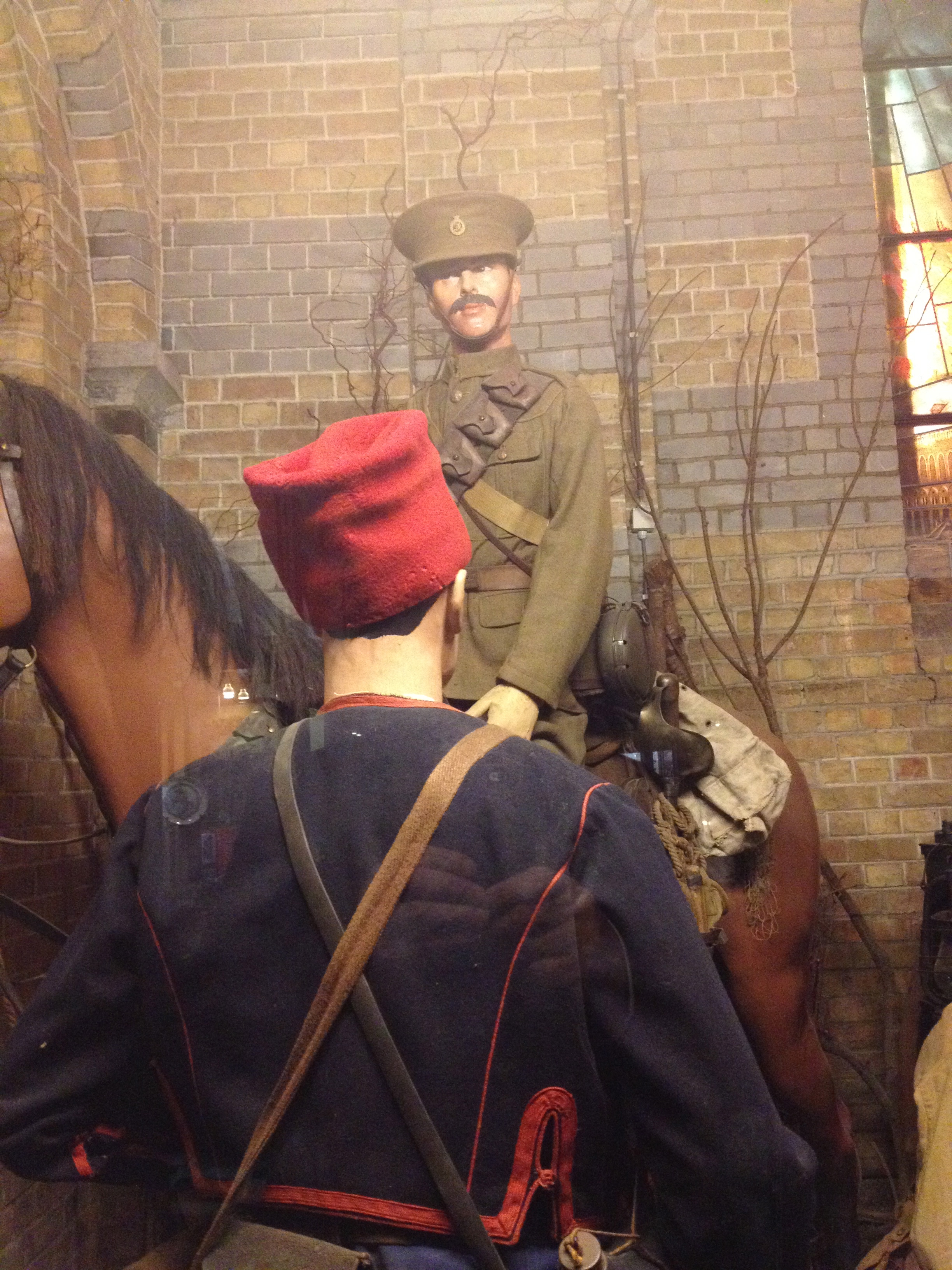
British cavalryman and French Zouave, brothers in arms at Ypres in October 1914, recreated in the cluttered but moving Museum at the Hooge Crater.
 First World War Memorials
Recent Comments